|
|
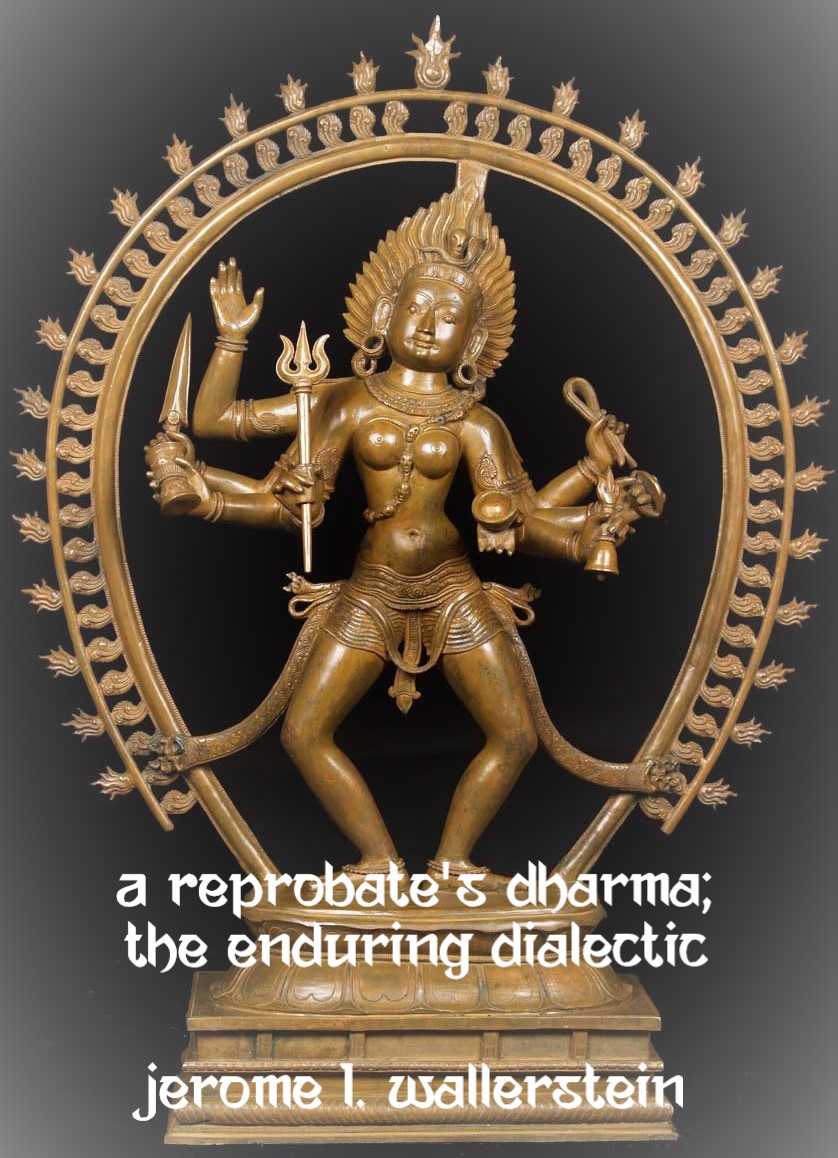
A Reprobate's Dharma; the enduring dialectic
|
|
This collection of Wallerstein's literary analects tackles a variety of subject matters; broadly categorized, a strong emphasis is placed upon his over-riding interests in eastern spiritualism, western philosophy and nature herself. Absent the pretension typically permeating academia, the work demonstrates how he reconciled what may seem to be diametrically opposed worlds to develop a definable philosophy and social dharma. A prolific playwright and novelist, Wallerstein has always subscribed to the notion that without published works an author is little different from a layman who keeps a journal. Through the publication of this introspective work, the author intended to release himself to once again pursue outward-facing novels and plays, free and clear from the nagging trepidation that he may have previously failed to fully and thoughtfully express his worldview. An ebook version is available from the author by clicking here, and a PDF version can be accessed by clicking here. Copyright and published in October 2018.
|
|
|

|
Analects And Miscellanea
|
|
A compendium of aphorisms and musings from Jerome Wallerstein, drawn from over three decades of his unpublished works; this unadorned and introspective novel provides insight into the author's fundamental belief system and offers some surprising revelations. An ebook version is available from the author by clicking here, and a PDF version can be accessed by clicking here. Copyright and published in September 2013.
|
|
|
|
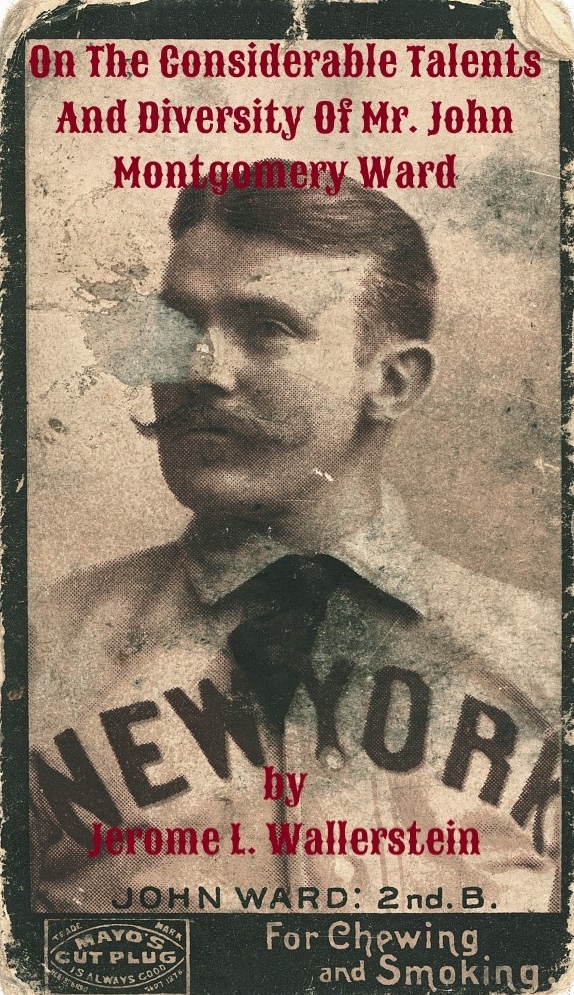
On The Considerable Talents and Diversity
of Mr. John Montgomery Ward
|
|
In this work of fiction, a man unearths an interesting manuscript in his mother's attic; the document turns out to be the transcripts to an unpublished interview conducted in 1924 with John Montgomery Ward, a Hall of Fame baseball player and one of the sport's true pioneers. As an educated man who also practiced law Ward was an anomaly as a ballplayer, and viewed as a controversial malcontent who went so far as to organize the players into a 'brotherhood', which competed directly with the National League. An ebook version is available from the author by clicking here, and a PDF version can be accessed by clicking here. Copyright and published in March 2008.
|
|
|
|
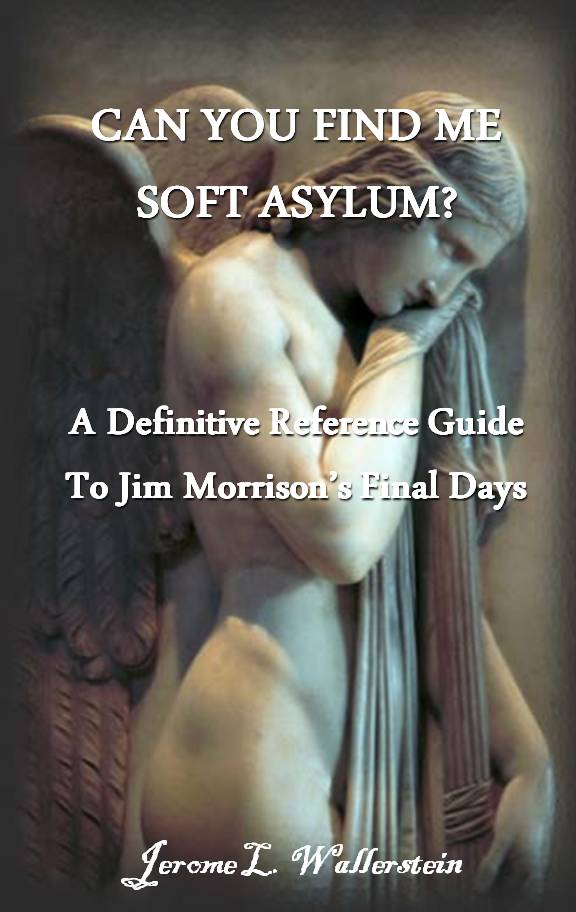
Can You Find Me Soft Asylum?
|
|
The circumstances behind the death of rock legend Jim Morrison remain shrouded in mystery and intrigue to this day. What really happened on that fateful evening in July 1971 - and exactly what role did Pamela Courson play in it all? Did she truly find him dead in her bathtub, or was his body transported to the apartment they shared after having expired elsewhere? After many years key individuals finally admitted to perpetrating a cover-up - for reasons that still resonate as specious to this day - and conflicting testimony leads us to question the degree to which drugs and foul play were involved. Quotes culled from a variety of sources illustrate the contradictions and incongruities found in the 'official' account of Morrison's passing, and allow the reader to draw his own conclusions. An ebook version is available from the author by clicking here, and a PDF version can be accessed by clicking here. Copyright and published in June 2004.
|
|
|

|
I Buried Paul
|
|
On an early November morning in 1966 a horrific car accident occurred not far from EMI Studios, where The Beatles had been working on their upcoming masterpiece 'Sgt. Pepper's Lonely Hearts Club Band'. Paul McCartney, The Beatles' charismatic and supremely talented bassist, died in this accident and yet somehow, someway, for some reason, the public was shielded from the truth. A look-alike was promptly recruited to replace McCartney, and The Beatles went on to produce the finest creations recorded in the annals of popular music. Why did the Beatles and their record label hide the truth? How did such a monumental tragedy escape public discovery? What evidence is there of the cover-up? How did it succeed? Where did this look-alike come from? Who was involved in the conspiracy, and what role did they play? For the first time ever these questions and more are answered by a man personally involved in the conspiracy. One of the few remaining participants confesses his involvement and exposes the truth behind the subterfuge, also explaining the rationale and process behind the bizarre 'clues' which The Beatles proceeded to give the public. The author's prologue is presented in its entirety at no charge by clicking here, to listen to an excerpt from the prologue select the file on this website's "SOUNDS" page. An ebook version is available from the author by clicking here, and a PDF version can be accessed by clicking here. Click here for a critic review, as it appeared on Earcandy.com. Copyright and published in September 2001.
|
|
|

|
The Kinks Kompanion
|
|
Ray Davies is one of rock and roll's most enigmatic, least understood and under-appreciated geniuses. Responsible for some of popular music's most enduring and catchy songs, Davies and his younger brother Dave have a long and well deserved reputation for using their intense love-hate relationship to fuel their witty and oh-so British writing. Wallerstein argues that in some of their early 1970 works, The Kinks brought to life traditional British Vaudeville (a.k.a. 'variety'). This is a complete biography starting with their births and covering all the years in between, up to and including the final breakup of The Kinks' original lineup in 1968. Click here for an excerpt, brought to you by Earcandy.com. An ebook version is available from the author by clicking here, and a PDF version can be accessed by clicking here.Copyright and published in January 1998.
|
|
|
|
Post Mortem
|
|
A struggling author finds himself increasingly unfocused and suffering from bouts of anxiety, loss of equilibrium and paranoia. An unwelcome letter arrives fromEurope informing him of the pending death of a relative, and urging him to come pay his respects before it is too late. Upon arrival in the city of his ancestors, his condition seems to worsen and he finds himself further taxed and worn. While visiting his relatives the man learns that he is a direct descendant of the mad composer Freiderick Schumann; this in turn leads to the discovery of an ugly family secret - there is a genetic predisposition toward insanity, and the man's symptoms precisely match those documented and charted by his celebrated relative. While this seems to hold the key to understanding what is happening, the question arises if perhaps the knowledge is contributing to a form of delusional hypochondria, or if in fact he is truly cognizant of a rapid descent into certifiable dementia. An ebook version is available from the author by clicking here, and a PDF version can be accessed by clicking here.Copyright and published in April 1989.
|
|
|

|
To Wander the Moonlit Path
|
|
A news correspondent is given an assignment that he does not particularly care for; to report on the recent guerilla movement for independence in Southwestern India. The reporter experiences the intense kaleidoscope of Indian life as he travels the subcontinent in search of stories. Although initially focused exclusively on his job and professional responsibilities, through his personal interactions - particularly those with a renowned "holy man" and his retinue - the reporter learns more about himself than he had ever anticipated. An affirming tale of self-exploration and discovery that speaks to the resilient nature of humans, and the depth of our primordial sense of spiritual kinship with the earth and nature. An ebook version is available from the author by clicking here, and a PDF version can be accessed by clicking here. Copyright and published in October 1986.
|
|
|
The Hog Chronicles, Part One;
The Born Loser
|
|
Wallerstein's early cartoon strip brought to life in novella form, the book follows the outrageous adventures of this tough-luck teenager and his very traditional Midwestern family. An ebook version is available from the author by clicking here, and a PDF version can be accessed by clicking here. Copyright and published in December 1985.
|
|
|
Brauderick; A Collection
|
|
At one time, Leonard Brauderick was an author of enormous potential. Suffering from exhaustion, Brauderick withdrew from the public eye, at one brief point being institutionalized, treated for depression, and released. This collection examines his legacy by presenting a wide array of literary works by the cult favorite. An ebook version is available from the author by clicking here, and a PDF version can be accessed by clicking here. Copyright and published in June 1985.
|
|
|
Conversation With An Artist
|
|
A contemporary painter struggles to reconcile himself to the harsh realities of today's art collecting scene. During a particularly trying evening he engages in a frank and introspective manner with a well-meaning friend, which leads the two of them to confront issues they'd both avoided in the past. An ebook version is available from the author by clicking here, and a PDF version can be accessed by clicking here. Copyright and published in February 1984.
|
|

|
The Journal
|
|
A woman seeks to gain insight into her boyfriend by reading his personal journal. Though she is rewarded by discovering a complex character, ultimately what is revealed creates for her even greater anxiety and uncertainty than she had prior to violating his trust - and of course, there can be no going back, can there? Wallerstein's first published novel. An ebook version is available from the author by clicking here, and a PDF version can be accessed by clicking here. Copyright and published in February 1984.
|